
Best Nano Banana Prompts for Car Drift Posters
The best car drift scene poster nano banana prompts work like miniature art direction briefs: name the car, define the drift moment, place it in a believable location, control the camera, specify the light, and add poster-safe constraints. If you only write "cool drifting car, cinematic, 8K," Nano Banana may produce a stylish image, but the result often feels generic. If you describe the exact drift angle, tire smoke, wet asphalt reflection, background depth, and what should not appear, the poster becomes much easier to control.
Use this guide when you want poster concepts for motorsport graphics, social media covers, gaming-inspired visuals, thumbnails, concept art, or mood-board assets. It is not for copying real movie posters, real game covers, logos, license plates, or branded racing liveries. Treat the examples below as adaptable prompt cases: keep the structure, swap the car and setting, and remove any brand or trademark detail you do not have rights to use.
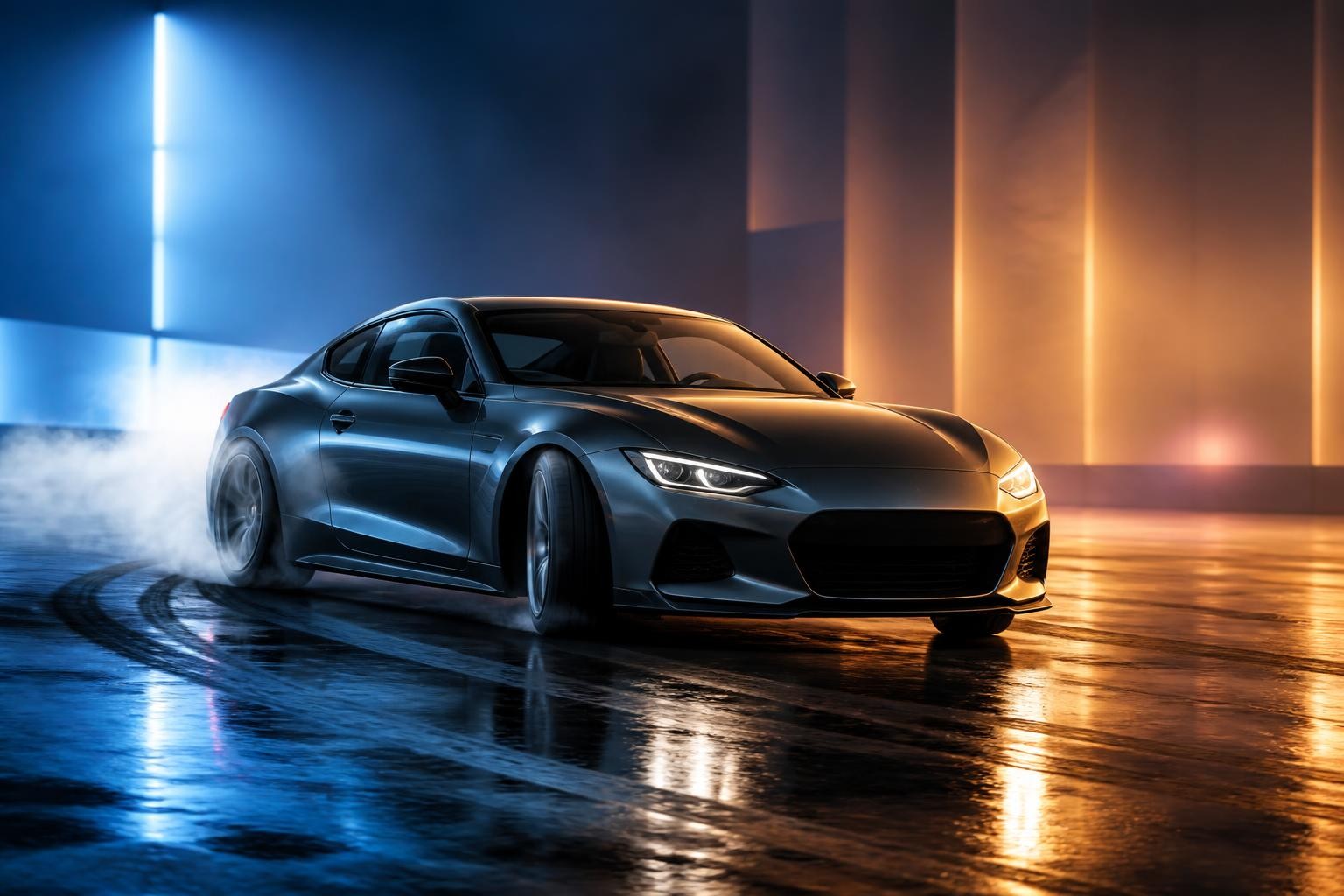
The Six-Part Formula Behind Strong Car Drift Scene Poster Nano Banana Prompts
A drift poster has to solve two problems at once. It needs to feel fast, but it also needs to read clearly as a still image. That is why the prompt should not only ask for speed. It should specify the visual evidence of speed.
Use this order:
1. Poster Job
Start with the asset type and use case.
Weak:
Create a cool car drift image.
Better:
Create a cinematic landscape poster image for an automotive drift scene, designed as a dramatic social media cover with one clear hero car and no readable text.
This tells Nano Banana that composition matters. A poster prompt needs clean framing, foreground hierarchy, and enough empty space for later design work if you plan to add typography outside the image generator.
2. Hero Car
Name the vehicle type without forcing a copyrighted or exact real-world asset unless you have permission. "A modified Japanese coupe," "a low-slung street racing car," "a matte black track car," or "a vintage compact drift car" is often enough.
If you do use a real model name for personal concept work, add preservation details that are visible:
Side profile, lowered stance, wide fenders, front wheels counter-steered, rear tires smoking, clean body shape, no readable license plate, no sponsor logos.
The important part is not the badge. It is the silhouette, stance, angle, and surface detail.
3. Drift Moment
A useful drift prompt describes where the car is in the maneuver:
Just entering the corner with the rear stepping out.
Mid-drift at a sharp angle with front wheels counter-steered.
Exiting the corner as smoke trails behind the rear wheels.
Donut drift in a wide empty lot with a circular smoke pattern.
For posters, mid-drift usually reads best because the car shape stays visible while smoke and tire marks show motion.
4. Scene and Atmosphere
The location should support the mood instead of competing with the car. Strong car drift scenes often use one of these environments:
Neon city street at night, rain-wet asphalt, reflections, steam, overhead signs without readable text.
Mountain road at blue hour, guardrail, trees, distant city lights, thin fog.
Industrial yard at dawn, concrete barriers, warehouse silhouettes, dust and smoke.
Forest road with sun rays, dry leaves, tire smoke catching warm light.
Empty game-like urban boulevard, saturated lighting, exaggerated depth, no logos or readable billboards.
Avoid adding too many settings at once. "Tokyo alley, forest road, desert, highway, rain, snow, sunset" gives the model mixed priorities.
5. Camera and Poster Composition
Camera language is where a prompt starts to feel like a poster instead of a random car image.
Use:
Low-angle three-quarter front view for power.
Side tracking shot for speed.
High drone angle for donut drifts and smoke rings.
Telephoto compression for mountain roads.
Wide landscape composition for blog and thumbnail use.
Leave the hero car fully visible unless the crop is intentional. A common failure in drift images is a dramatic smoke cloud that hides the car. Tell Nano Banana to keep the whole vehicle readable.
6. Constraints
Constraints are not boring; they are what make the image usable.
Add:
No readable text, no logos, no watermarks, no license plate numbers, no real sponsor decals, no movie title, no game title, no extra cars unless requested, keep the full car visible, avoid distorted wheels.
These constraints are especially important for poster assets because image models may invent signs, plates, decals, or fake typography when asked for city scenes or promotional art.
Prompt Case 1: Neon Street Drift Poster
Use this when you want the classic night-city drift look without copying a specific film still.
Prompt:
Create a cinematic landscape poster image of a modified Japanese street racing coupe performing a controlled mid-drift through a neon-lit city street at night. The car is shown in a low-angle three-quarter front view, rear tires producing thick white smoke, front wheels counter-steered, wet asphalt reflecting pink, blue, and amber lights. Add steam rising from the street, soft background motion blur, sharp detail on the car body, dramatic side lighting, and a clear hero composition. Keep the full car visible. No readable text, no logos, no license plate numbers, no watermarks, no movie title, no sponsor decals.
Why it works:
It separates the poster job, car, action, city atmosphere, camera angle, and constraints. The prompt does not rely on "cinematic" alone; it gives visible proof of cinematic drift: smoke, wet reflections, counter-steer, side light, and background blur.
How to adjust it:
For a cleaner commercial look, reduce smoke and ask for a polished studio-grade finish. For a more underground look, add gritty pavement, handheld camera energy, and harsher flash highlights. For a thumbnail, ask for a stronger diagonal road line and more contrast between the car and background.
Prompt Case 2: Furious Tokyo Drift Car Drift Scene Poster Nano Banana Prompts
The search phrase furious tokyo drift car drift scene poster nano banana prompts usually points to a very specific mood: neon city racing, sideways motion, Japanese street-car energy, rain, smoke, and a movie-poster finish. The trick is to borrow the visual language without asking for a direct recreation of a copyrighted poster or scene.
Prompt:
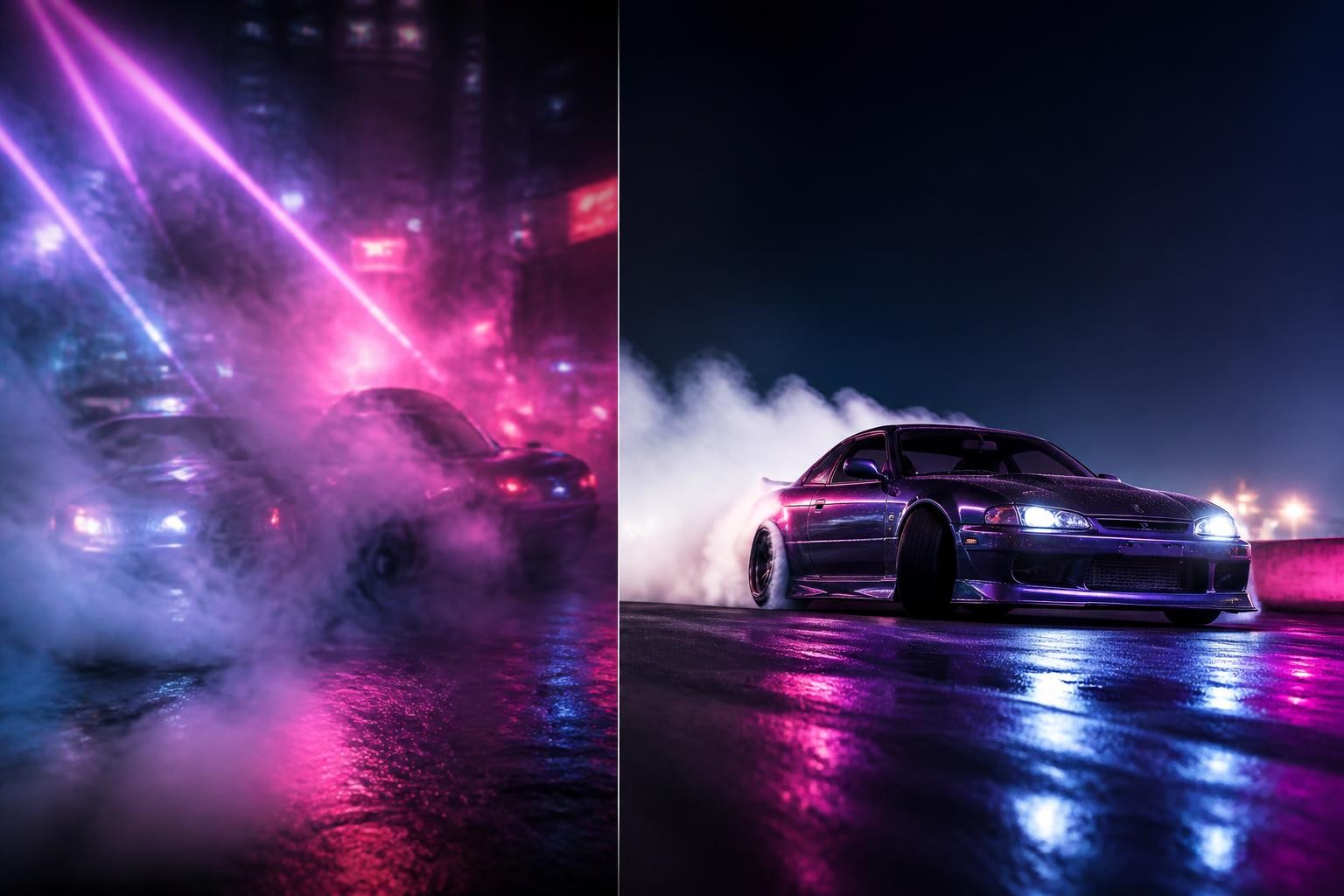
Create a high-energy car drift poster inspired by neon Japanese street racing culture, with a tuned sports coupe sliding sideways through a rain-soaked urban intersection at night. Use a dramatic low camera angle close to the road, bright underglow reflecting on puddles, taillight streaks, tire smoke curling behind the rear wheels, and tall city buildings fading into atmospheric haze. The car should feel fast but remain crisp and fully readable. Use a bold cinematic color grade with electric blue shadows and warm orange highlights. No recognizable movie characters, no readable signs, no title text, no logos, no real brand marks, no license plate numbers.
Why it works:
It captures the intent behind the phrase without depending on protected characters, titles, or exact compositions. The scene stays usable as an original poster concept.
Nano Banana revision prompt:
Make the car more dominant in the frame while preserving the same drift angle, wet street reflections, neon lighting, smoke direction, and landscape poster composition. Reduce background clutter and keep all text-like shapes unreadable.
That follow-up is useful because first generations can become too busy. Revision prompts should preserve the parts that work instead of starting over.
Prompt Case 3: Forest Drift Movie Poster
Forest drift posters work when the smoke, road curve, and light direction are clear. If the prompt only says "car drifting in forest," the model may produce a car parked on a road with mist. Add the maneuver.
Prompt:
Create a cinematic forest-road drift poster in landscape 3:2 format. A dark graphite sports coupe enters a sharp mountain curve mid-drift, front wheels counter-steered, rear tires throwing pale smoke and dust into warm sun rays between tall trees. The camera is low and slightly ahead of the car, with a sweeping road line leading into the frame. Use natural green forest tones, golden backlight, realistic tire marks, subtle motion blur in the background, and crisp reflections on the car body. Keep the car fully visible and centered slightly off-axis for poster energy. No readable text, no logos, no license plate, no racing decals, no extra vehicles.
Why it works:
The prompt gives Nano Banana a physical scene: curve, counter-steer, dust, sunlight, road line, camera position. Those details are more reliable than simply requesting "dramatic."
Best use:
Motorsport event mood boards, editorial blog imagery, outdoor racing concepts, and cinematic thumbnails where neon city scenes would feel too predictable.
Prompt Case 4: GTA V Nano Banana Prompt for an Original Game-Poster Mood
A gta v nano banana prompt should avoid copying the real game cover, logo, characters, UI, or illustrated panel layout. The safer and more useful direction is to capture open-world driving energy: saturated city light, stylized realism, cinematic action, and a poster-ready composition.
Prompt:
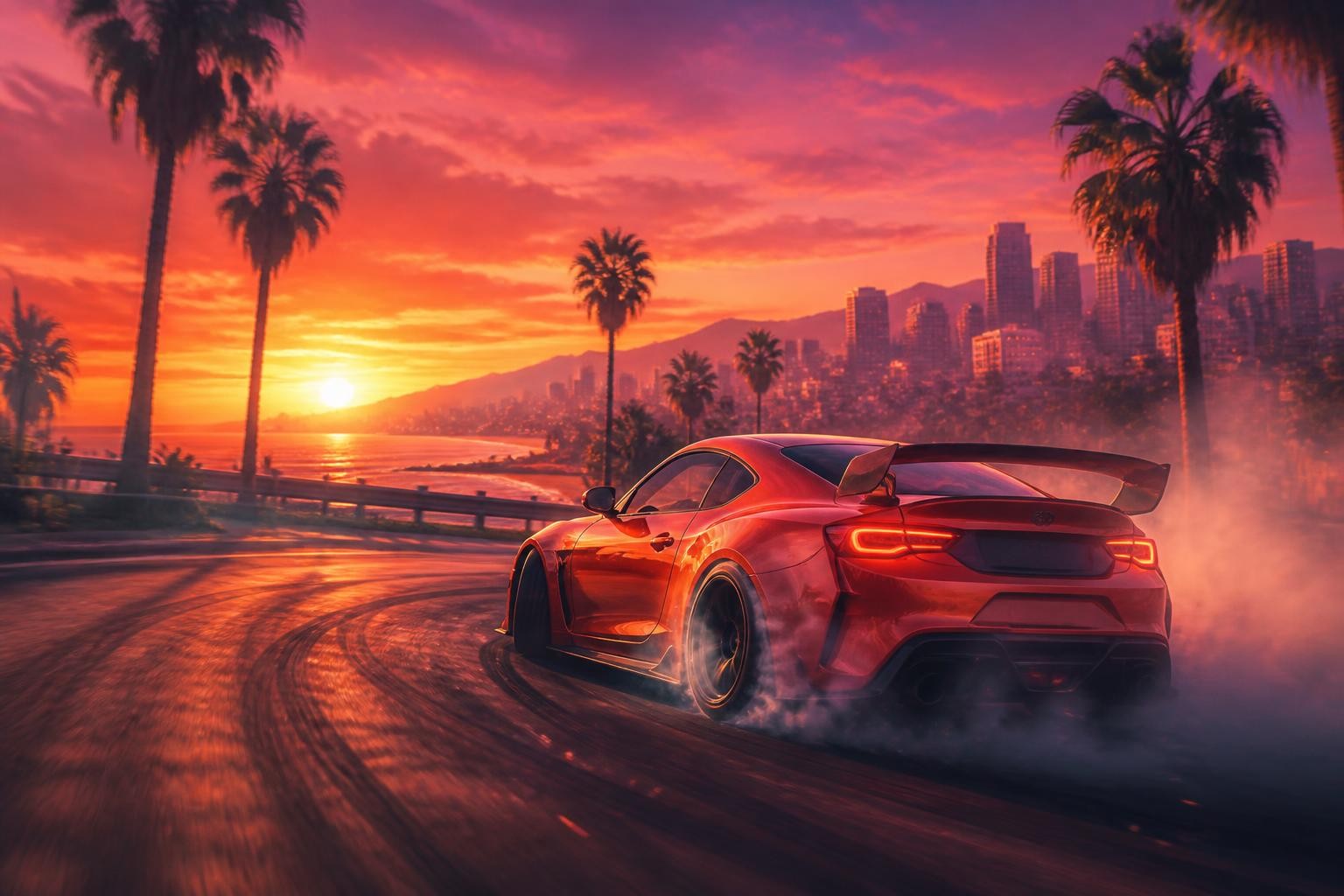
Create an original open-world driving game-inspired drift poster, not based on any existing game cover. Show a bright yellow performance car drifting through a wide coastal city boulevard at sunset, with palm silhouettes, road dust, tire smoke, and dramatic orange-pink sky reflections on the car body. Use a polished stylized-realistic finish, high-contrast poster lighting, strong diagonal road perspective, and one clear hero vehicle in the foreground. Add distant traffic shapes only as blurred background atmosphere. No game logo, no title, no readable text, no characters, no weapons, no UI, no license plate numbers, no brand marks.
Why it works:
It uses the useful parts of game-cover energy without asking Nano Banana to imitate an existing cover. It also avoids the biggest failure modes: invented typography, fake logos, and cluttered multi-panel layouts.
Variation:
Create a split-mood version: the left side has warm sunset reflections on the car, the right side fades into cool city night lighting, with the same car continuing one drift arc through both lighting zones. No readable text or logos.
This variation is useful for creators who want an editorial poster with more visual contrast.
Prompt Case 5: Minimal Black-and-White Drift Poster
Not every drift poster needs neon. A monochrome image can look more premium if the silhouette and smoke shape are strong.
Prompt:
Create a black-and-white automotive drift poster with a single vintage coupe sliding through an empty concrete track at night. Use a side tracking composition, strong rim light, deep shadows, heavy tire smoke forming a sweeping arc behind the car, visible tire marks on the asphalt, and sharp detail on the wheel motion. The mood should feel restrained, graphic, and editorial. Keep the background minimal and the full car readable. No readable text, no logos, no license plate numbers, no watermarks, no crowd, no extra cars.
Why it works:
Black-and-white prompts need shape and contrast more than color. The smoke arc becomes the poster graphic, while the car remains the anchor.
How to Turn One Prompt Into a Better Poster
Nano Banana is often strongest when you treat the first output as a draft. Do not rewrite everything after a near miss. Use targeted revision prompts.
If the Car Looks Parked
Ask for more physical drift evidence:
Increase the drift angle, turn the front wheels opposite the slide, add rear tire smoke, show curved tire marks, and add background motion blur while keeping the car sharp.
If the Smoke Hides the Car
Ask for separation:
Reduce the smoke in front of the car, move the thickest smoke behind the rear wheels, keep the hood, roofline, front wheels, and side profile clearly visible.
If the Poster Feels Flat
Ask for stronger hierarchy:
Move the car closer to the camera, use a low-angle hero composition, darken the distant background, add rim light along the car edge, and keep one clear diagonal road line.
If the Scene Gets Messy
Ask for fewer elements:
Remove extra cars, crowds, signs, random decals, and unreadable poster text. Keep one hero car, one road curve, one lighting direction, and one dominant smoke shape.
If It Generates Text
Ask for an image-only version:
Remove all readable text, letters, numbers, logos, license plate characters, signs, captions, stickers, and watermarks. Replace signs with abstract light panels and blurred shapes.
This is especially important for car drift scene poster nano banana prompts because city streets, racing liveries, and game-inspired posters all invite accidental text.
A Reusable Template for Your Own Drift Poster Prompts
Copy this structure and replace the bracketed parts:
Create a cinematic landscape poster image of [car type] performing [specific drift moment] in [location and time of day]. Show [drift evidence: counter-steer, tire smoke, tire marks, dust, sparks, reflections]. Use [camera angle and composition], with [lighting and color grade]. Keep [what must remain clear]. The image should feel [poster mood] and be usable as [asset use]. No readable text, no logos, no license plate numbers, no watermarks, no real sponsor decals, no copied movie or game title.
Example filled version:
Create a cinematic landscape poster image of a low black street racing coupe performing a mid-drift around a tight urban corner at midnight. Show front wheels counter-steered, thick smoke behind the rear tires, bright wet-pavement reflections, curved tire marks, and subtle sparks under the rear bumper. Use a low-angle three-quarter front composition, electric blue rim light, warm streetlamp highlights, and a dark background with soft motion blur. Keep the full car readable and sharply detailed. The image should feel like an original motorsport poster for a social media cover. No readable text, no logos, no license plate numbers, no watermarks, no real sponsor decals, no copied movie or game title.
What to Avoid in Car Drift Poster Prompts
Avoid stuffing quality tags at the end. "Ultra realistic, 8K, masterpiece, cinematic, HDR" may add polish, but it does not tell the model what to draw.
Avoid copying a known poster. Use original cars, original framing, and descriptive mood language.
Avoid asking for readable typography inside the generated image unless you are prepared to regenerate and inspect every letter. For blog images, thumbnails, and ad backgrounds, it is cleaner to add final text manually in a design tool.
Avoid overloading one prompt with every drift trope. Neon, forest, snow, rain, desert dust, police chase, skyline, anime, photorealism, and game-cover collage will fight each other.
Avoid unsafe or illegal-action framing if the asset will be used commercially. You can make the scene feel intense without showing crowds in danger, pedestrians in the road, or real public-street racing instructions.
Quick Prompt Picks by Goal
For a social media cover, use a low-angle neon city drift with one hero car and strong reflections.
For an editorial blog image, use a cleaner forest or track drift where the car shape is easy to read.
For a gaming-inspired poster, use open-world energy, saturated color, and original composition without copying a real title.
For a premium automotive brand mood, use monochrome lighting, fewer props, and a clear smoke arc.
For a thumbnail, increase contrast, simplify the background, and keep the car large enough to read on mobile.
Final Checklist Before You Generate
Before running a car drift poster prompt, check whether it answers these questions:
What is the poster for?
What kind of car is the hero?
What exact drift moment is happening?
Where is the scene, and what is the lighting?
Where is the camera?
What visual details prove motion?
What should stay out of the image?
If the prompt answers all seven, Nano Banana has a much better chance of producing a useful poster asset instead of a stylish but disposable car picture.
Ready to create and refine your own poster concepts? Try car drift scene poster nano banana prompts with a clear drift moment, a controlled camera angle, and image-only constraints so the final visual is easier to publish, crop, and edit.
